






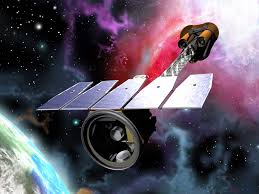
The Imaging X-ray Polarimetry Explorer (IXPE) is a mission which is part of the NASA SMEX space programme, whose principal investigator is Dr. Martin Weisskopf from the NASA/Marshall Space Flight Center (MSFC) in Huntsville, Alabama, United States.
The IXPE, launched on December the 9th 2021, will carry on board 3 telescopes, with detectors capable of measuring the polarization of X-rays emitted by astronomic sources, with a sensitivity which is two orders of magnitude over the X-ray polarimeter aboard the Orbiting Solar Observatory OSO-8, a mission that operated between the end of the 60’s and the beginning of the 70’s. The detectors were developed by a team of INFN and INAF researchers and funded by the Italian Space Agency. The Italian team has a long experience in the field of detectors for measuring the polarization of X-rays, because they have been working on it since the 70’s. The grazing incidence mirrors of the telescopes, instead, were developed at the NASA/MSFC by a team guided by Dr. Brian Ramsey. Finally, the spacecraft and the satellite integration fall under the responsibility of the Ball Aerospace, located in Broomfield, Colorado. The satellite will be launched on April 2021 aboard the Falcon 9 rocket, from the Launch Complex 39A in Florida, and its circular orbit will be at 540 km altitude and 0 degrees inclination.
During the first two years of mission, the IXPE will open a new astrophysical window. The main targets of the mission will be active galactic nuclei (AGN), micro quasars, pulsars and pulsar wind nebulae, magnetars, X-ray binaries, remnants of supernovae and the Galactic Centre. The IXPE will provide simultaneous spectral measurements of polarization, variability and images, allowing thereby to study the geometry and physical processes of radiation emissions and particle acceleration, in environments with extreme magnetic and gravitational fields.