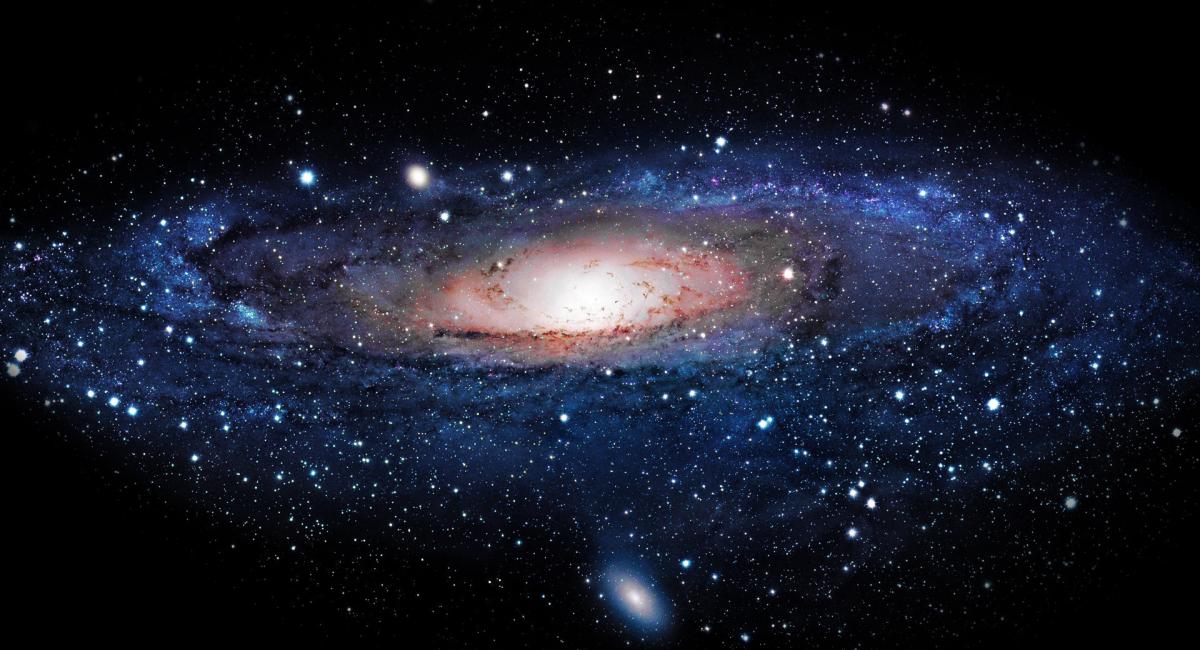







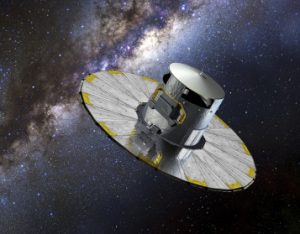
Gaia is a mission of the ESA scientific programme, aimed at obtaining a three-dimensional map of our galaxy by showing its composition, formation and evolution.
The launch was carried out on December 19th, 2013, with the Soyuz-Fregat vector, the orbit occupied by the satellite is that around L2.
Gaia is directly manufactured by the ESA, also for the scientific instrumentation part which consists of two telescopes with different field sights and a common focal plane, a set of mirrors and more than a hundred CCDs, corresponding to almost one billion pixels.
The mission will continuously scan the entire sky, by taking advantage of the rotation and precession motions of the satellite: every area of the sky is observed about seventy times during the operational life of the satellite. The participation of the European scientific community to the mission involves the responsibility to reduce the huge amount of data that will be produced by the mission. Such task is carried out by the Data Processing and Analysis Consortium (DPAC), the consortium of European research institutes created by the European scientists in response to an Announcement of Opportunity by the ESA.
Gaia is obtaining astrometric data related to over one billion stars, with a two hundred-times higher accuracy than Hipparcos, and astrophysical information on the luminosity of the different spectral bands that will allow to study in detail the formation, dynamics, chemistry and evolution of our galaxy.
The Italian contribution to the DPAC is significant (second only to the French contribution) and involves, in particular, taking part in the definition and implementation of the analysis and data calibration pipelines and the presence on the Italian territory of one of the six expected Data Processing Centers (DPCs).
The Gaia mission falls within the framework of the ESA Scientific Programme, to which Italy contributes about 13%.