






Subject line: Formation, differentiation and evolution of the internal Planets
Responsibility: ESA mission
Date of launch: November 9th, 2005
End of mission: December 16th, 2014
Description
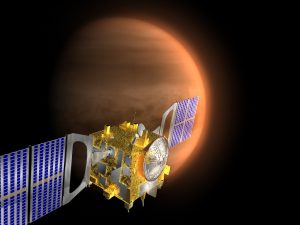
The Venus Express mission was selected by the ESA among three different reuse proposals for buses and instruments already manufactured for the Mars Express and Rosetta missions. After a 150-day journey, it reached Venus on April 11th, 2006, and after a few manoeuvres (guided by the ESA control centre in Darmstadt, Germany) to reduce its speed, it entered its final orbit on May 7th.
The altitude of the orbit ranged between 66.000 and 250 kms from the planet’s surface, and it took 24 hours for the probe to complete an orbit. In view of the excellent results obtained and the potentiality and perfect functionality of the spacecraft, on February 23rd, 2007, the SPC unanimously approved the extension of the mission until May 2009, with an additional extension until the end of 2016. On December 16th, 2014, the mission was officially declared over.
Scientific goals
The scientific topic from which the Venus Express mission was born was looking for an answer as to why Venus, whose size, composition and distance from the Sun are similar to Earth, had a completely different evolution which caused it to have totally different atmosphere and totally different surface conditions, dominated by a strong greenhouse effect that can cause the planet to reach temperatures of 750° K. Therefore, the exploration of Venus can provide important information on the evolution processes of the Solar System, in general, and the greenhouse effect, in particular. Furthermore, the discovery of atmospheric windows in the close infrared, around the micron, allowed to study the atmosphere at different altitudes up to the surface. This is impossible for cameras in the visible spectrum, due to the huge thickness and density of atmospheric gases (carbon dioxide for the most part) that reach pressures of the order of 200 atmospheres above ground.
Italian contribution
Italy contributed to the mission with the PI-ship of two instruments: VIRTIS (Visible and Infrared Thermal Imaging Spectrometer, PI Giuseppe Piccioni from the ASF-INAF in Rome), an imaging spectrometer in the visible/close infrared spectrum, identical to the spectrometer in flight on the Rosetta mission, which supplies data relative to the atmosphere, surface and to their interactions; PFS (Planetary Fourier Spectrometer, Vittorio Formisano from the IFSI-INAF in Rome), which performs vertical scans of the atmosphere and is identical to the instrument in flight on the MarsExpress mission. Furthermore, there was a significant participation in manufacturing the ASPERA-4 (Analyzer of Space Plasmas and Energetic Atoms) instrument, which studies the interactions between the solar wind and the Venusian atmosphere and is identical to the instrument in flight on the MarsExpress mission.