






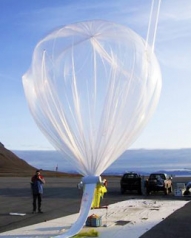
Trapani-Milo (decomissioned since 2010)
The Trapani-Milo Stratospheric Balloon Launch Base - no longer operational since the summer of 2010 - first opened in 1975 and for over 30 years was one of the few facilities in the world capable of guaranteeing ballooning in all its phases - designing, launch, and flight control with special expertise for heavy payloads.
The following is the Launch Base Fact Sheet when it was running:
The launch pad is housed at an old airport facility on a vast area of over 90 hectares on the outskirts of Trapani, ideally located for trans-Mediterranean and transatlantic launches. Due to its former use, the base has a large launch pad with direct visibility from the control tower, and a control center fully equipped with advanced tracking and communication systems.
The base has four hangars for payload integration and testing. During the past few years, different types of balloons have been launched from the base, ranging from 100,000 m3 balloons to 1,100,000 m3 balloons.
For its first twenty years of operation, the base's activities focused almost exclusively on balloon launches. Today, thanks to new information and telecommunications technologies, it also performs support activities for small space missions, provides support to developing countries for access to space, and works in the field of technology transfer and support for small- and medium-sized enterprises (SMEs).
Balloons represent an alternative or an important complement to satellites or the International Space Station: as far as atmospheric physics is concerned, balloons are a preferred research tool; for astrophysics and the study of cosmic rays, they are an agile complementary method that allows for quick, cost-effective answers. Baloons also offer promising results in many areas of engineering and biomedicine.
The Trapani-Milo Base is managed by ASI that develops programs, funds operations and makes investments in the various fields of activities. The Base operates in collaboration with other national and international agencies and institutes (CNR, ENEA/PNRA, Universities) as well as international agencies (NASA, ESA, INTA).
Among the most important experiments recently launched from the Trapani-Milo base the following are worth mentioning:
FIGARO, an Italian-French Astronomy experiments managed by CERS (CNES) and IFCA/IAS (CNR)
PALLAS, an X-ray Astronomy experiment of the IAF/IAS (CNR) and the University of Southampton.
ARGO, for IR Astronomy, from the IROE/IFA (CNR)
PHOSWICH, X-ray Astronomy balloon of the ITESRE (CNR)
LAPEX, X-ray Astronomy experiment operated by the ITESRE/IAS (CNR) and CERS (FR) institutes
ARD, ESA's Atmospheric Reentry Demonstrator (ARD), an experimental system to launch a vehicle into space and recover it safely.
S.Q.M., a nuclear research cooperative project launched by CNR institute in Turin and the University of Tokyo
HASI - the Huygens Atmospheric Structure Instrument (HASI) is a multisensor package on board of the Cassini-Huygens probe designed to measure the physical quantities characterizing Titan's atmosphere. It is operated by the University of Padua.
BIRBA (Biological Research on Balloons), a series of biomedical experiments conducted by various Italian universities and laboratories
BABY (BAckground BY-pass), a balloon-borne experiment conducted by the IASF-CNR in Palermo to study cosmic rays through the detection of UV light.
SAFIRE - B an experiment for measuring atmospheric composition with FIR Spetroscopy conducted by IFAC-CNR, Florence, Italy.
In the period between 2008 and 2009 other launches deserve to be mentioned: PEGASUS (Polar Explorer for Geomagnetism And other Scientific Observations) by the National Institute of Geology and Volcanology; OLIMPO 1 and 2 (experiments by the University of Rome - La Sapienza) to measure the anisotropy of cosmic background radiation; SORA, new launches of BOOMERANG (Balloon Observations of Millimetric Extragalactic Radiation and Geophysics) by 'Sapienza' the University of Rome; HIPEG (platform for X-ray astronomy experiments); STRADIUM; and EDUCATIONAL.