






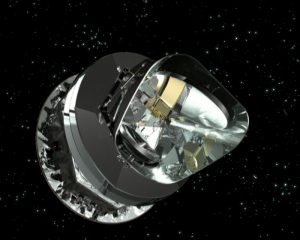
The Planck mission is the third Medium-Sized Mission (M3) of the ESA Horizon 2000 programme and aims at studying the cosmic microwave background. Aboard the satellite are two sophisticated instruments: the Low Frequency Instrument (LFI) and the High Frequency Instrument (HFI), designed and manufactured by international consortia of scientific institutes, with the support of the industry.
The lift-off happened in May 2009, along with the Herschel satellite. After the launch, the two satellites separated to reach the L2 Lagrange point, 1.5 million km away from Earth, where they carried out the respective observation programmes. The expected operating life of Planck was 21 months from the end of the commission stage, which was subsequently extended. Planck has reached the planned goal of carrying out two complete observations of the entire celestial vault.
At the end of the mission, the satellite was put into a heliocentric orbit and the shuttle was reclaimed by removing the residual energy in it, in order to avoid dangers for future missions. The switch-off command was sent to the satellite on October 23rd, 2013.
The mission aimed at measuring, with a high angular resolution and accuracy, the cosmic microwave background in the microwave frequency range, with the purpose of improving our knowledge on the origins and the evolution of the Universe.
Italy was in charge of manufacturing the Low Frequency Instrument, a set of 11 horn antennas and 22 radiometers placed in the focus of the Planck satellite’s telescope, that operated in the bands centred at the frequencies of 30, 44 and 70 GHz. The instrument consisted of two parts, the first one cooled to 250 °C and the second one cooled to a temperature proximal to environmental temperature. The two parts are connected by long waveguides “carrying” the microwaves captured from the sky. The Principal Investigator (PI) is Nazzareno Mandolesi from the INAF-IASF in Bologna.
As regards the High Frequency Instrument, under the responsibility of France, the Italian participation involves supplying the cryogenic preamplification, developed on behalf of the ASI by the Department of Physics of the University of Rome “La Sapienza” and by the Selex Galileo.
For both instruments, the Italian scientists were strongly involved in the scientific activity related to the mission, which for the first time carried out a mapping of the entire celestial vault in the frequency range of microwaves.