





The European Space Agency (ESA) and the Japan Aerospace Exploration Agency (JAXA) have signed a Memorandum of Cooperation to deepen collaboration in planetary defence, alongside a dedicated agreement for collaboration on the Ramses (Rapid Apophis Mission for Space Safety) mission to the near-Earth asteroid Apophis.
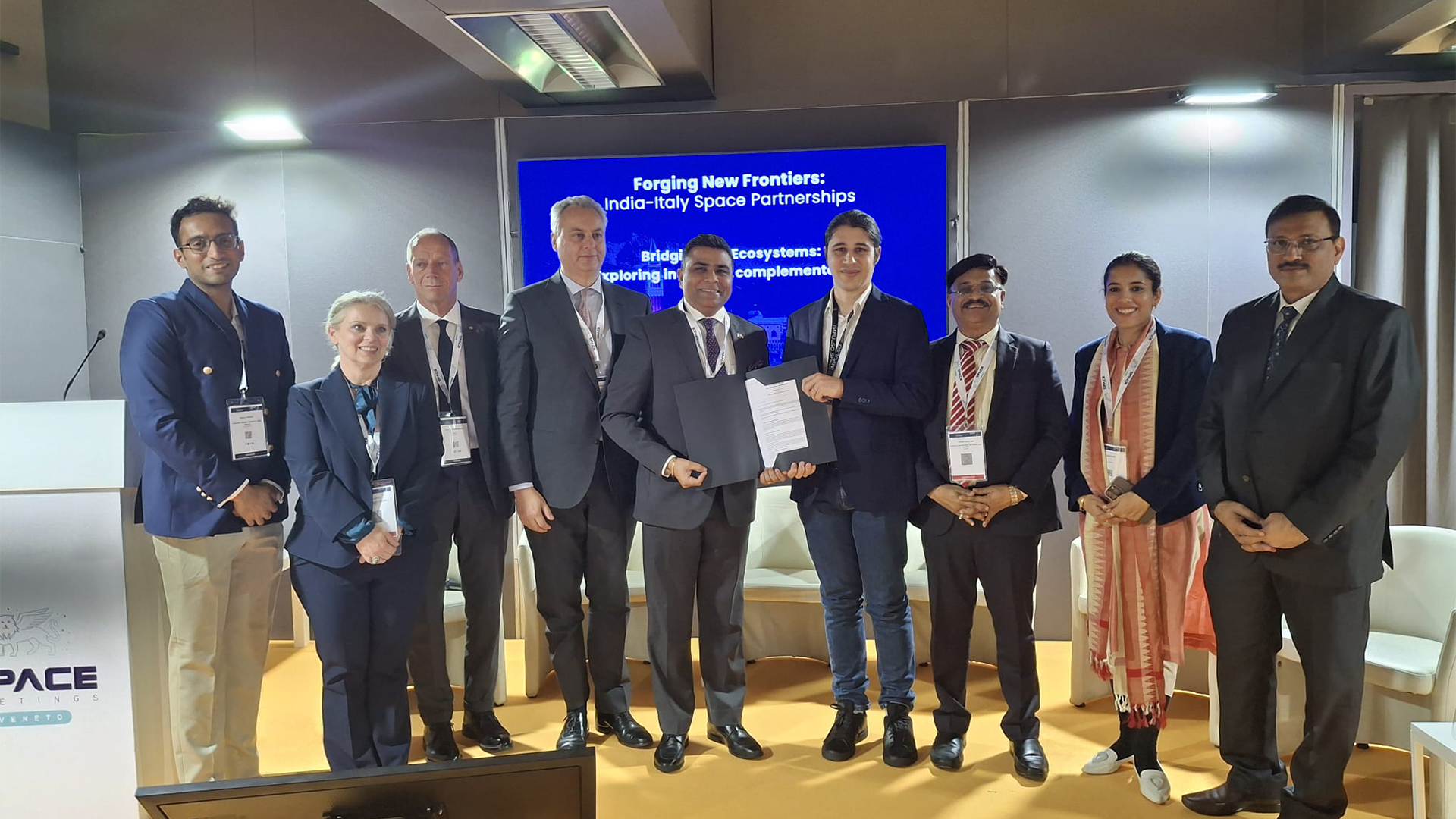
The agreements were signed on 7 May by ESA Director General Josef Aschbacher and JAXA President Hiroshi Yamakawa at the Embassy of Italy in Berlin, Germany, in the presence of European and Japanese institutional and industrial leadership. The event was hosted in collaboration with the Italian Space Agency (ASI), in light of ESA’s selection of OHB Italia as prime contractor for the Ramses mission.
The move builds on a joint statement from November 2024, in which ESA and JAXA committed to expanding large-scale cooperation, including on planetary defence.
“Planetary defence is, by definition, a global responsibility,” said ESA Director General Josef Aschbacher. “With today’s signatures, ESA and JAXA are moving decisively from shared intention to concrete implementation, translating commitment into mission‑level cooperation. This partnership builds on trust, technical excellence and a shared determination to protect our planet. In an increasingly complex environment, international cooperation remains a cornerstone of Europe’s approach to space. Together, ESA and JAXA are showing how reliable partners turn ambition into action for the benefit of all.”
“We are pleased to have signed today the Memorandum of Cooperation and the agreement to advance cooperation on planetary defense”, said Jaxa President Hiroshi Yamakawa. “We sincerely appreciate ESA and its Member States, including Italy, and expect this cooperation to further advance international efforts in this field.”
A global effort
Planetary defence is a challenge affecting every human and living being on Earth. As a field of applied scientific research, it brings together the international community to detect and characterise near-Earth objects early, track their trajectories, assess impact risks, and develop mitigation strategies if needed. By strengthening ESA–JAXA cooperation on planetary defence, the two agencies are committing to advancing this global effort.
ESA plays a leading role in planetary defence through its Space Safety programme. The programme’s Near-Earth Object Coordination Centre (NEOCC) monitors asteroid threats and refines orbit predictions, while its space missions oversee the development of rapid reconnaissance and deflection technologies.
The agency’s Hera planetary defence mission, for example, on which JAXA is an important partner, will arrive later this year at the Didymos binary asteroid system. There, it will help turn asteroid deflection by kinetic impact into a reliable and understood technique for protecting our planet.
The Ramses mission to Apophis
The first major outcome of the new ESA-JAXA cooperation is collaboration on the Ramses mission. Ramses will launch in 2028 and rendezvous with the asteroid (99942) Apophis ahead of its exceptionally rare, close flyby of Earth in April 2029.
Roughly 375 metres across, Apophis will pass just 32 000 km above Earth’s surface on Friday 13 April 2029 – one tenth the distance to the Moon and closer than satellites in geosynchronous orbits.
While there is no risk of impact, the flyby is extraordinarily rare, occurring only once every 5 000 to 10 000 years for an object of this size. Visible in the night sky to the naked eye for up to two billion people on Earth, the event will offer a unique opportunity for science and public engagement.
Ramses will accompany Apophis throughout the flyby, observing how Earth’s gravity alters its shape, surface and motion. By comparing before-and-after measurements, scientists will gain insights into asteroid structure, composition and behaviour that will be important for any future deflection efforts.
ESA oversees the Ramses mission’s spacecraft design, integration and operations. JAXA will provide key elements, including the spacecraft’s lightweight solar arrays, an infrared imager, and launch aboard its H3 rocket. The partnership builds on JAXA’s contribution to Hera and ongoing collaboration on ESA-JAXA space missions such as EarthCARE and BepiColombo.
Until now, we have had to travel deep into the Solar System to study asteroids and interact with their surfaces. With Apophis, for the first time ever, nature is bringing an asteroid to us and conducting the experiment itself. As the asteroid is pulled and reshaped by tidal forces, ESA and JAXA will be there to capture every moment of this once-in-a-lifetime opportunity.
Photo credits: Jorge Pérez de Lara