



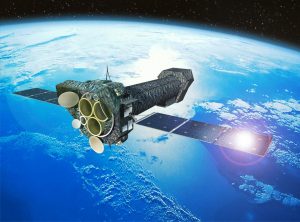
The X-ray Multi-Mirror (XMM) was the second “cornerstone” in the “Horizon 2000” programme by the European Space Agency (ESA). Renamed XMM-Newton in honour of the great British physicist Sir Isaac Newton, it represents the most important European contribution to astronomy in the X-ray band.

The satellite was launched on December 10th, 1999 from Kourou (French Guyana), with a 504 Ariane vector. It is equipped with three X-ray telescopes with an unprecedented collection area and a visible-band telescope. Thanks to its great sensitivity and the possibility to carry out long, uninterrupted observations, it’s an extremely powerful instrument for astronomy in the X-ray band ranging from 0,2 to 10 keV.

In cooperation with other European institutes and with the contribution of the Italian Space Agency (ASI), the National Institute for Astrophysics (INAF) developed the European Photon Imaging Camera (EPIC), the main XMM-Newton instrument. EPIC consists of three independent CCD detectors, placed on the focal plane of the tree XMM telescopes. The INAF was in charge of the AIV process of the instrument, and actively contributed to nearly all the stages of the development of EPIC, from designing to ground calibration.

Starting from the launch, XMM-Newton discovered hundreds of thousands of X-ray sources, many of which were studied in an extremely detailed manner from a spectral and temporal point of view. XMM is providing a very important contribution to solve several unresolved problems in the field of astrophysics, from black hole physics to the origin of the Universe. XMM observation time is made available to the scientific community through a yearly competitive call.
‣ Latest News

FRIDAY 08 MAY 2026

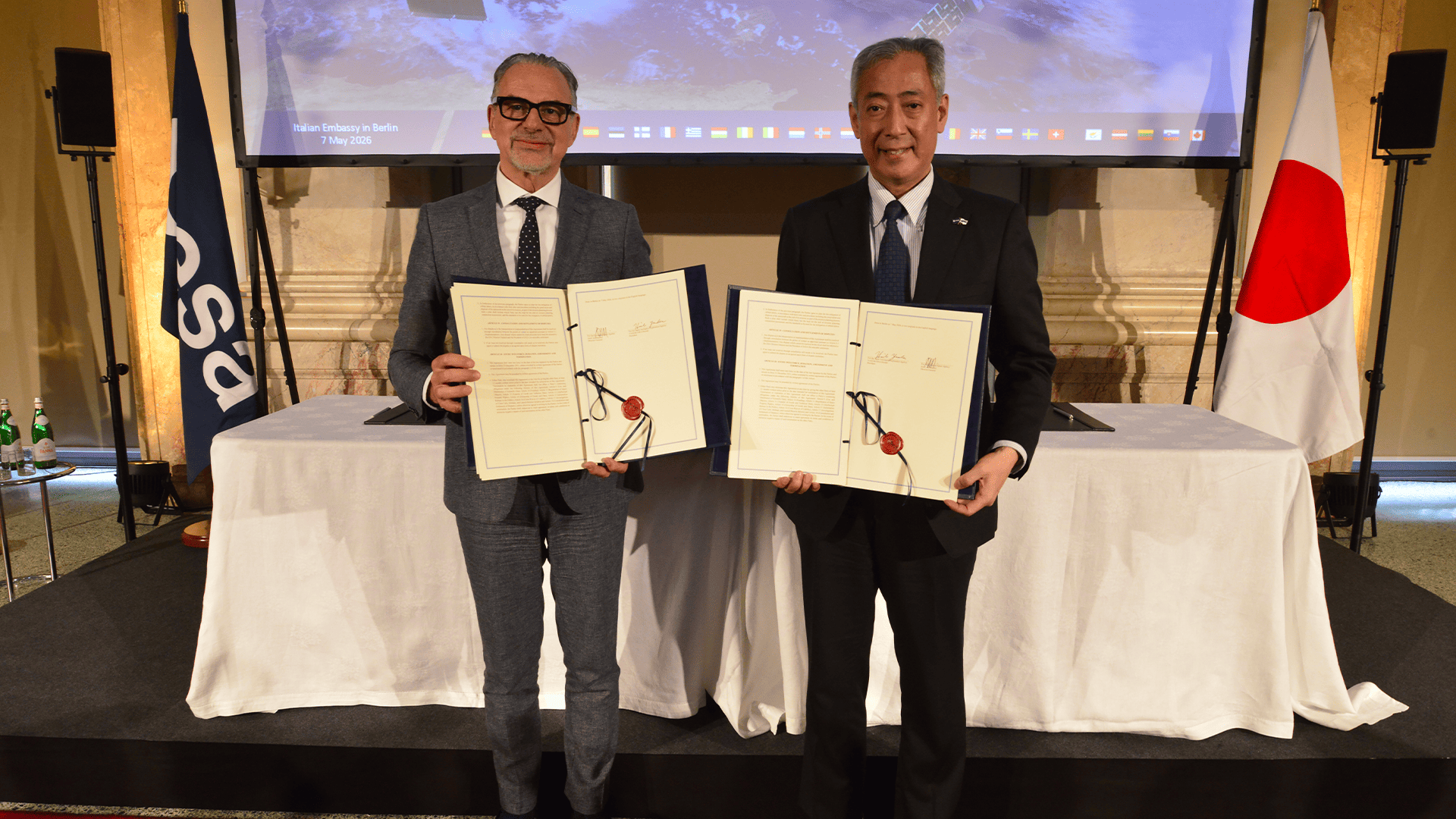
ESA and JAXA team up on planetary defence, Ramses mission to asteroid Apophis ‣

The cooperation agreement signed today at the Italian Embassy in Berlin for the mission with significant Italian participation MORE...

TUESDAY 28 APRIL 2026

Centro Nazionale Competenze GNSS – Successfully concluded the second edition of the School on GNSS Technologies ‣

The second edition of the course, promoted by ASI and held at its Centre within Telespazio, concludes with strong international participation MORE...

MONDAY 30 MARCH 2026

IRIDE continues its development: eight more Eaglet II satellites in orbit ‣

European Space Agency (ESA), Italian Space Agency (ASI) and OHB Italia: The programme of the Italian Government marks another success  MORE...

THURSDAY 22 JANUARY 2026

First parabolic flight testing for the next smart biosuit for astronauts EMSi_MK.02 ‣

Le prove della tuta durante il volo parabolico

The EMSi-MK.02 wearable device will act as a countermeasure to the negative effects of microgravity on the astronaut’s Musculo-skeletal system MORE...

MONDAY 19 JANUARY 2026

FIRST LOOK AT EARTH FROM THE COSMO-SKYMED FM3 SATELLITE ‣

Roma - La città eterna vista dal nuovo satellite COSMO-SkyMed di seconda generazione. Nell’immagine si individuano immediatamente la basilica di San Pietro, il Colosseo, le Stazioni di Termini e Tiburtina, Villa Borghese e Villa Ada e lo Stadio Olimpico

Just days after launch, the first images are received from the third satellite of the second generation of the Earth Observation programme promoted by the Italian Space Agency and the Ministry of Defence, involving national industry with Leonardo, Thales Alenia Space, Telespazio and e-GEO MORE...